

ABSTRACT
GROWTH AND YIELD OF BROCCOLI (Brassica oleracea L. var. italica) INFLUENCED BY SEEDLING AGE AND PLANT DENSITY
Journal: Plant Physiology and Soil Chemistry
Md. Rasedul Islam Moon, Md. Mokter Hossain, Tamanna Haque, Md. Mehedi Hasan Hafiz, Afsana Yasmin
This is an open access article distributed under the Creative Commons Attribution License CC BY 4.0, which permits unrestricted use, distribution, and reproduction in any medium, provided the original work is properly cited
DOI: 10.26480/ppsc.01.2025.27.34
1. INTRODUCTION
Broccoli (Brassica oleracea L. var. italica) is one of the most nutrient-dense vegetables. It belongs to the Brassicaceae family. Vegetables are an essential part of human nutrition. It contains carbohydrates, lipids, minerals, vitamins, and roughages, all of which are necessary components of a well-balanced diet (Roy, 2011). The average vegetable intake of Bangladeshis is well below the FAO recommendation, which states that a person should consume at least 200 g of vegetables each day (FAO, 2017). Phytochemicals that promote health, such as nitrogen-sulfur derivatives, polyphenols, minerals (Se, K, and Mn), and vitamins (A, C, K, and B6), are abundant in broccoli (Baenas et al., 2012; Fuente et al., 2019). Broccoli’s ability to prevent cancer is not new; prior research has linked these advantages to the plant’s high concentration of glucosinolates, which are active phytochemicals (Zhao et al., 2007). Among the Cole crops, this is regarded by many as the most elegant. When the primary apical bloom head is harvested, broccoli, in contrast to cauliflower, generates tiny flowering shoots from the leaf axis (Roni et al., 2014).
In agricultural production, seedling age and plant spacing have a big impact on growth and yield. Seedling age is one of the key factor in attaining a high yield and better return on broccoli. Delaying planting resulted in a lower yield. Crop yield increases with earlier planting dates and decreases linearly with later planting dates (Soniya et al., 2019; Ruyi et al., 2012). Compared to late-planted crops, early-planted crops had a longer lifespan, produced taller plants with more leaves, a larger plant spread, a higher leaf size index, and the lowest percentage of aberrant curds, which was ultimately linked to a better curd production (Hossain and Mohona, 2018; Hoque, 2006; Das et al., 2000). Therefore, there is ample opportunity to determine the best time to plant broccoli in order to maximize its output. Due to the fact that older transplants were more flexible in the field than younger ones, older transplants were occasionally more adaptive than younger ones (Choi et al., 2002).
The growth and development broccoli are greatly influenced by the planting spacing. The main head yield and overall broccoli output exhibited a similar trend in response to plant spacing. An area’s head size, average marketable head weight, and maturity were all decreased by a higher plant population (Haque et al., 2015). The optimum plant spacing plays a key role for crop production through efficient utilization of nutrients, water and light by the plants. In general, the higher plant population adversely affect the yield per unit area hampering plant growth and development (Islam et al., 2017). Plant spacing is one of the most crucial cultural practices for plant growth and development since it influences crop growth rate, canopy development, soil moisture loss, weed management, and light interception. The larger plant spacing declined the number of plants per unit area.
Depending on how close they are grown they can also receive less air than they require for proper growth. Plants can therefore be more vulnerable to deposition of essential nutrients if they are not provided enough space (Ara et al., 2007). There is very little information available regarding the impact of seedling age and plant spacing on broccoli development and productivity. Adopting better production techniques, such as appropriate plant spacing, seedling age, and planting strategy, can boost broccoli yield. It was noted that seedling age and plant spacing have a vital impact on broccoli growth, development and yield. Considering the above all aspects, the present study was undertaken to investigate the impact of seedling age and plant spacing on growth, yield attributes and yield of broccoli and to select a suitable seedling age for transplanting with an optimum plant density for commercial cultivation of broccoli.
2. MATERIALS AND METHODS
2.1 Description of study area
This study was conducted at the Horticulture Farm, Department ofHorticulture, Bangladesh Agricultural University, Mymensingh,Bangladesh during October 2017 to March 2018. The experimental areabelongs to the Agro-ecological zone-9 (AEZ-9) Brahmaputra Flood Plain(FAO, 1988). The site of the experiment is located at 24°75′ N latitude and90°50′ E longitude at a height of 18 m above the sea level.
2.2 Land preparation and raising of seedlings
The experimental plot was ploughed on 2 October, 2017 by a tractorattached with disc plough to make good tilth condition. The land was thencarefully ploughed multiple times with a power tiller and then laddered.To get different age groups seedlings, seeds of broccoli cv. Early You F1hybrid were sown in the seedbed at 15, 22, 29 October and 5 November,2017, respectively. Proper care was taken to produce healthy, diseasesfree seedlings for transplanting in the experimental plots.
2.3 Experiential design and treatment
The factorial experiment was carried out following randomized completeblock design with three replications. Factor A consisted of three seedlingages viz., A1: 14 days, A2: 21 days, A3: 28 days, and A4: 35 days old andFactor B consisted of three levels of plant spacing viz., S1 (60 cm x 60 cm),S2 (60 cm x 50 cm) and S3 (60 cm x 40 cm). The experimental plot wasdivided into three blocks. Each block consisted of 12 plots and the totalnumber of plots were 36. The size of a unit plot was 3 m x 2 m. A distanceof 0.5 m between the plots and 1 m between the blocks was kept. In eachblock, combinations of seedling age and plant spacing were assignedrandomly according to treatment combination.
2.4 Application of manures and fertilizers
The experimental plot was fertilized with well-decomposed cowdung,nitrogen, phosphorus, potassium, sulphur, zinc and boron at the rate of 10tons, 105, 36, 60, 18, 2 and 1.2 kg per hectare, respectively (FRG, 2012). N,P, K, S, Zn, and B were obtained from urea, triple super phosphate (TSP),muriate of potash (MoP), gypsum, zinc sulphate, and borax, respectively.Half of the cow dung and the whole amount of TSP, gypsum, zinc sulphate,and borax were applied during the final land preparation. The remainingquantity of cow dung was applied before transplanting of seedlings. Ureaand MoP were applied at 15, 30, and 45 days following transplantation(FRG, 2012).
2.5 Intercultural operations
Light irrigation was applied immediate after transplanting. Floodirrigation was applied after each top dressing of fertilizer. Manual weedingwas done three times during the growth period of broccoli. For controllingfungus infestation, Ridomil Gold (at 2g/L water) was applied thrice at themorning hour. The older and dead leaves of broccoli were discarded fromthe field.
2.6 Collection of data
To prevent border effect, five plants were chosen at random from eachplot’s center rows. At 15, 30, and 45 days after transplanting (DAT),respectively, measurements of the plants’ height and leaf count weretaken. At harvest, measurements were taken of the curd yield, crownspread, length of the biggest leaves, primary curd diameter, primary curdweight, secondary curd number, weight, and stem diameter.
2.7 Statistical analysis
The MSTAT statistics tool was used to statistically evaluate data on various parameters. The F-test was used to analyze the variance for each character once the mean for each treatment was determined. The least significant difference (LSD) test was used to assess the significance of the differences between the treatment mean pairs (Gomez and Gomez, 1984).
3. RESULTS
3.1 Growth parameters of broccoli
Seedlings age and plant spacing significantly affected plant growth parameters. Plant height and leaf number of broccoli were significantlyinfluenced by the different age of seedling, plant spacing and combinationof seedling age and plant spacing at different days after transplanting(DAT). Plant height of broccoli gradually increased with time progressed.Seeding age significantly influenced the height of plant. At 45 DAT, thelongest plant height (20.79 cm) was observed from A4 treatment (35-dayold seedling) and the shortest plant height (17.21 cm) from A1 treatment(14-day old seedling) (Figure 1A). Plant height of broccoli alsosignificantly influenced by the plant spacing. At 45 DAT, the highest plantheight (20.09 cm) was found from S1 treatment (60 cm x 60 cm) and theminimum plant height (17.75 cm) from S3 treatment (60 cm x 40 cm)(Figure 1B).
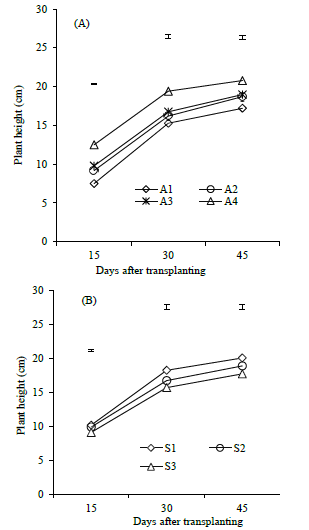
Figure 1: Effect of seedling age (A) and plant spacing (B) on plant heightof broccoli at different days after transplanting. Vertical bars representLSD at 5% level of significance. Here, A1: 14 days, A2: 21 days, A3: 28days, A4: 35 days, S1: 60 cm x 60 cm, S2: 60 cm x 50 cm, S3: 60 cm x 40cm.
The combined effect of seedling age and plant spacing was significant onplant of broccoli. At 45 DAT, the longest plant height (23.0 cm) was foundfrom A4S1 treatment (35-day old seedling with 60 cm x 60 cm) and theshortest plant height (15.0 cm) from A1S3 treatment (14-day old seedlingwith 60 cm x 40 cm) (Table 1).
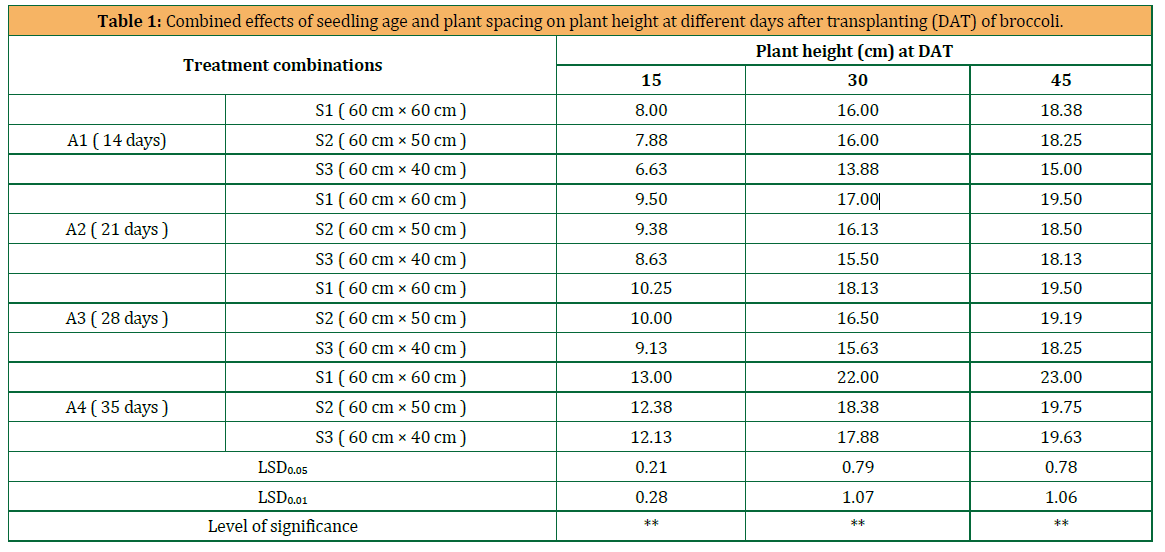
** indicates significant at 1% level of probability
Similarly, leaf number of broccoli impacted by the age of seedlings as wellas plant spacing. At 45 DAT, the maximum number of leaves (14.83) wasrecorded from A4 treatment (35-day old seedling) and the minimumnumber of leaves (12.67) from A1 treatment (14-day old seedling) (Figure2A). At the same time i.e., at 45 DAT, the maximum number of leaves(14.59) was counted from S1 treatment (60 cm x 60 cm) and the minimumnumber of leaves (13.22) from S3 treatment (60 cm x 40 cm), (Figure 2B).


Figure 2: Effect of seedling age (A) and plant spacing (B) on number ofleaves of broccoli at different days after transplanting. Vertical barsrepresent LSD at 5% level of significance. Here, A1: 14 days, A2: 21 days,A3: 28 days, A4: 35 days, S1: 60 cm x 60 cm, S2: 60 cm x 50 cm, S3: 60 cmx 40 cm.
The combined effect of seedling age and plant spacing was foundsignificant on number of leaves of broccoli. At 45 DAT, the A4S1 treatmentcombination (35-day old seedling with 60 cm x 60 cm) produced themaximum number of leaves (15.50), whereas the A1S3 treatment (14-dayold seedling with 60 cm x 40 cm) produced the minimum leaves (11.13)(Table 2).
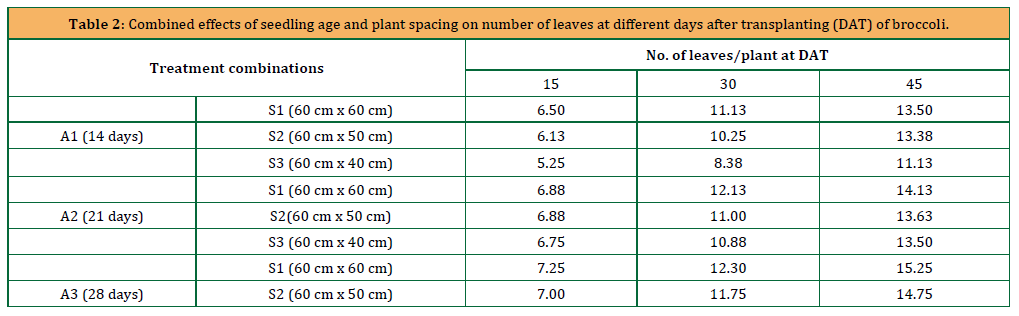
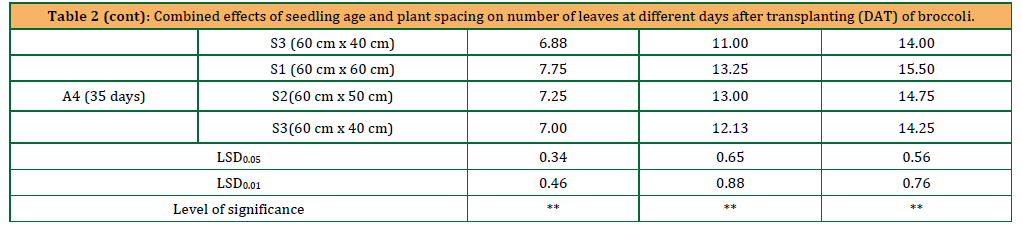
** indicates significant at 1% level of probability
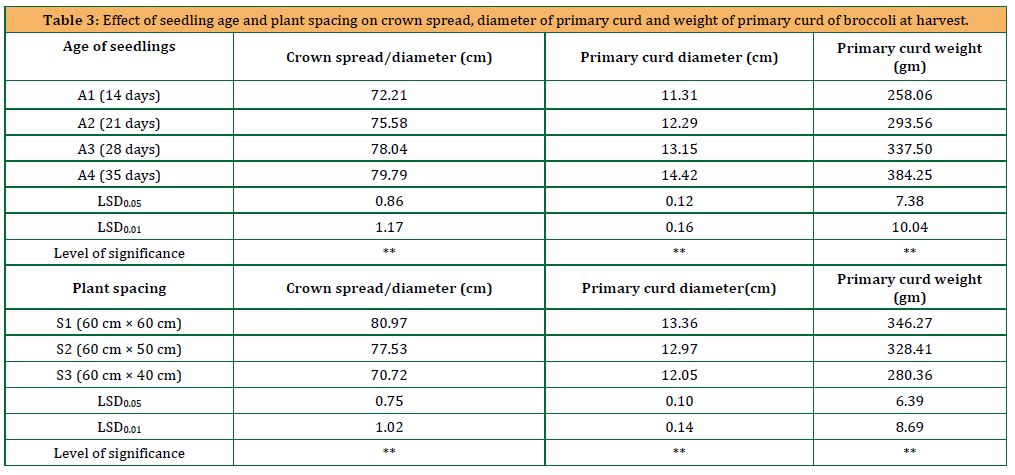
Plant spacing and seedling age differences had a major impact on crown spread. The 35-day-old seedling had the largest crown spread (79.79 cm), followed by the 28-day old (78.04 cm) and 21-day-old (75.58 cm) seedlings, in that order. The seedling that was 14-day old had the smallest crown spread (72.21 cm) (Table 3). Plant spacing S1 (60 cm × 60 cm) produced the largest crown spread (80.79 cm), followed by 60 cm x 50 cm spacing (77.53 cm), and 60 cm x 40 cm spacing generated the smallest crown spread (70.72 cm) (Table 3).
The seedlings that were 35-day old had the biggest diameter of primary curd (14.42 cm), followed by those that were 28-day old (13.15 cm) and 21-day old (12.29 cm), in that order. The seedling that was 14-day old had the smallest diameter of primary curd, measuring 11.31 cm (Table 3).
Primary curd’s biggest diameter (13.36 cm) was measured at 60 cm × 60 cm spacing, followed by 60 cm x 50 cm spacing (12.97 cm), and the smallest diameter (12.05 cm) was measured at 60 cm x 40 cm spacing (Table 3).
In terms of primary curd weight, the 35-day old seedling weighed the most (384.25 gm), followed by the 28-day old (337.50 gm) and 21-day old (293.56 gm) seedlings, respectively. From seedlings that were 14-day old, the minimal weight of primary curd (258.06 gram) was found (Table 3). With 60 cm × 60 cm spacing, the primary curd’s weight reached its maximum (346.27 gm), followed by 60 cm x 50 cm spacing (328.41 mg), and 60 cm x 40 cm spacing produced the lowest weight (280.36 gm) (Table 3).
** indicates significant at 1% level of probability
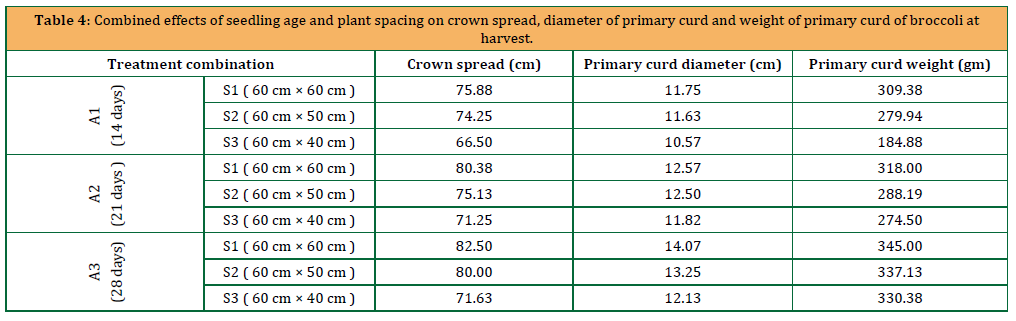
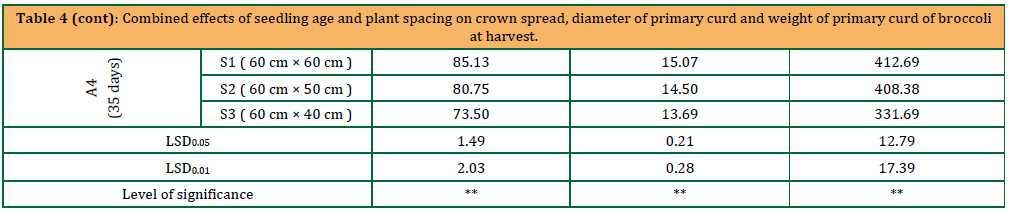
The A4S1 treatment (35-day old seedling with 60 cm x 60 cm spacing) had the largest crown spread (85.13 cm), whereas the A1S3 treatment (14-day old seedling with 60 cm x 40 cm spacing) had the smallest crown spread (66.50 cm) (Table 4). The A4S1 treatment provided the biggest primary curd diameter (15.07 cm) with a seedling that was 35 days old and spaced 60 cm by 60 cm apart, whereas the A1S3 treatment generated the smallest primary curd diameter (10.57 cm) with a seedling that was 14 days old and spaced 60 cm by 40 cm apart (Table 4). The A4S1 treatment (35-day old seedling with 60 cm × 60 cm spacing) gave the highest weight of primary curd (412.69 gm), whereas the A1S3 treatment (14-day old seedling with 60 cm x 40 cm spacing) delivered the lowest weight of primary curd (184.88 gram) (Table 4).
** indicates significant at 1% level of probability
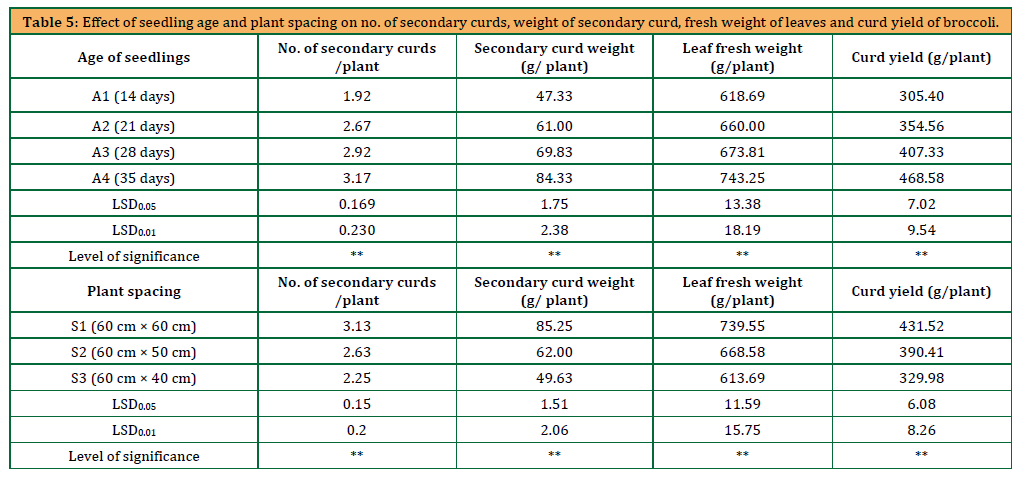
Number of secondary curd was significantly influenced by the different seedling age and plant spacing. The maximum number of secondary curd (3.17) was recorded from 35-day old seedling followed by 28-day old seedling (2.92) and 21-day old seedling (2.67). The minimum number of secondary curd (1.92) was recorded from 14-day old seedling (Table 5). The maximum number of secondary curd (3.13) was obtained from 60 cm x 60 cm spacing followed by 60 cm x 50 cm spacing (2.63) and minimum number of secondary curd (2.25) was obtained from 60 cm x 40 cm spacing (Table 5).
The 35-day old seedling produced the highest weight of secondary curd (84.33 gm), followed by its 28-day old counterpart (69.83 gm) and 21-day old counterpart (61.00 gm). From seedlings that were 14-day old, theminimum weight of secondary curd (47.33 grams) was attained (Table 5). At 60 cm × 60 cm spacing, the secondary curd’s weight reached its maximum of 85.25 gm, followed by 60 cm x 50 cm spacing (62.00 gm), and at 60 cm x 40 cm spacing, it reached its minimum of 49.63 gm (Table 5).
In terms of fresh weight of leaves, the 35-day old seedling had the highest (743.25 gm), followed by the 28-day old seedling (673.81 gram) and the 21-day old seedling (660.00 gm), in that order. The 14-day old seedling had the lowest fresh weight of leaves (618.69gm) (Table 5). 60 cm × 60 cm spacing produced the highest fresh weight of leaves (739.55 gm), followed by 60 cm x 50 cm spacing (668.58 mg), and 60 cm x 40 cm spacing produced the lowest weight of secondary curd (613.69 gram) (Table 5).
** indicates significant at 1% level of probability
The A4S1 treatment formed the most secondary curd (4.0), while the A1S3 treatment produced the fewest (1.75). The A4S1 treatment produced seedlings that were 35-day old and spaced 60 cm by 60 cm apart (Table 6). With a seedling that was 35-day old and spaced 60 cm by 60 cm apart, the A4S1 treatment delivered the highest weight of secondary curd (116.0 g), whereas the A1S3 treatment produced the lowest weight (38.50 gm) with a seedling that was 14-day old and spaced 60 cm by 40 cm (Table 6). The A4S1 treatment, which generated 35-day-old seedlings spaced 60 cm by 60 cm apart, had the highest fresh weight of leaves (784.69 gm), while the A1S3 treatment provided the lowest weight of secondary curd (510.00 gm) from seedlings that were 14-day-old and spacing 60 cm × 40 cm (Table 6).
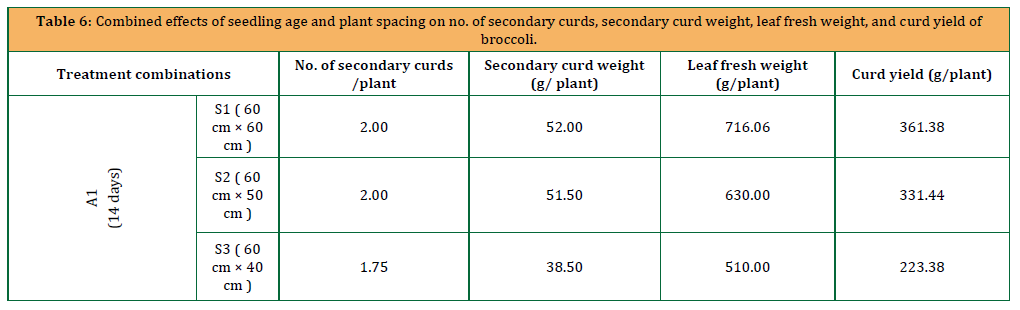
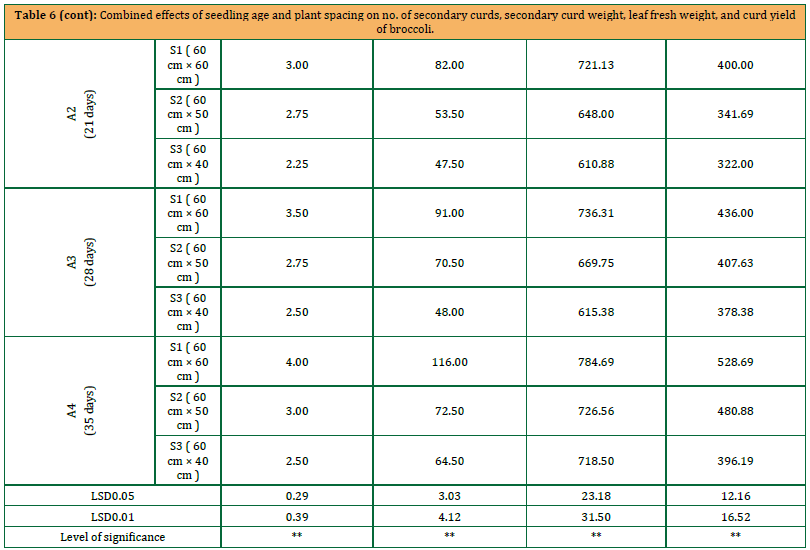
** indicates significant at 1% levels of probability.
3.2 Yield parameters of broccoli
Yield per plant was significantly influenced by the different seedling ageand plant spacing. Maximum yield per plant (468.58 gm) was countedfrom 35-day old seedling followed by 28-day old seedling (407.33 gm) and21-day old seedling (354.56 gm), respectively. Minimum yield per plant(305.40 gm) was acquired from 14-day old seedling (Table 5). Maximumyield per plant (431.52 gm) was observed from 60 cm x 60 cm spacingfollowed by 60 cm x 60 cm spacing (390.41 gm) and minimum yield perplant (329.98 gm) was observed from 60 cm x 40 cm spacing (Table 5).The maximum yield per plant (528.69 gm) was obtained from A4S1 (35-day old seedling with 60 cm x 60 cm) and the minimum yield per plant(223.38 gm) from A1S3 (14-days old seedling with 60 cm x 40 cm) (Table6). The varying seedling ages have a major impact on yield per hectare.The 35-day old seedling had the highest yield per hectare (15.25 t),followed by the 28-day old seedling (13.42 t) and the 21-day old seedling(11.60 ton), respectively. The 14-day old seedling delivered the lowestyield per hectare (9.80 t) (Figure 3A). Regarding plant spacing, 60 cm x 40cm spacing supplied the highest output per hectare (13.75 t), followed by60 cm x 50 cm spacing (13.01 t), and 60 cm x 60 cm spacing supplied thelowest yield per hectare (10.79 t) (Figure 3B). When seedling age andplant spacing were combined, the A4S3 treatment delivered the highestyield per hectare (16.51 t) with a 35-day old seedling spaced 60 cm by 40cm, whereas the A1S1 treatment generated the lowest yield per hectare(9.03 t) with a 14-day old seedling spaced 60 cm by 60 cm (Figure 4).
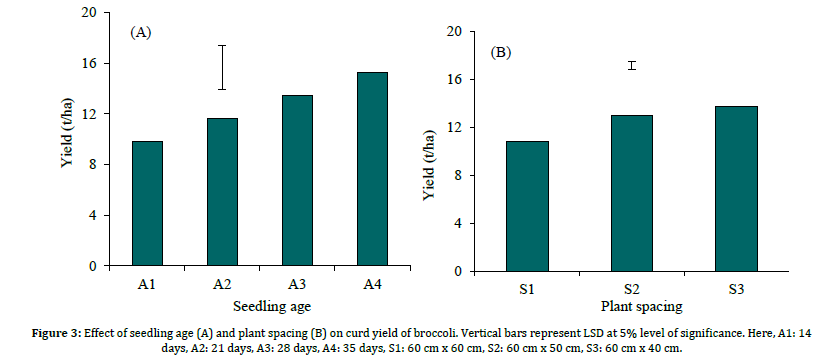
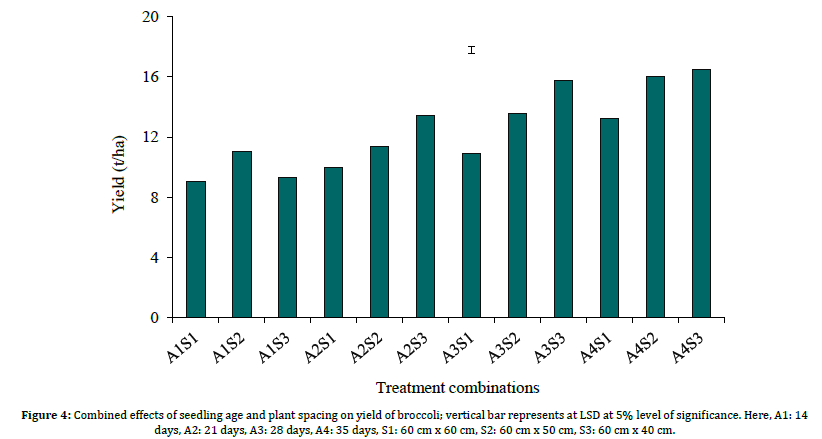
4.DISCUSSION
Broccoli development and output were significantly impacted by seedling age and plant spacing. In this experiment, the 35-day old seedlings had the most leaves; this could be linked to the vegetative development stage’s optimal temperatures, which result in higher photosynthetic activity and assimilate mobilization (Kaymak et al., 2009). It was found that plants with greater plant separation had more leaves, while plants with closer spacing had less leaves. It most likely results from interplant competition, which limits access to resources like fertilizers (Ullah et al., 2013). The quantity of leaves was significantly impacted by the interaction between plant spacing and seedling age. The highest plant height from older seedlings and maximum plant spacing. This could be because there is more room for growth, as well as more nutrients, moisture, and sunshine (Mourao et al., 2007). The result of plant height is partially contradictory with (Thirupal et al., 2014); they found maximum plant height at closer spacing (50 cm x 30 cm). This could be because plants that are closer together have more terminal development than plants that are farther apart, which have more lateral growth. Furthermore, compared to younger transplants, elder transplants shown greater adaptability in the field (Solunke et al., 2011). Maximum crown spread from wider spacing and older seedlings; they recorded among the plant spacings, 60 cm × 45 cm the highest crown spread (84.38 cm) followed by 45 cm x 45 cm (Sharif, 2008).
We also found maximum curd diameter and maximum curd weight from wider spacing and older seedlings. The bigger size and weight of heads may have been due to better food accumulation in plants grown at wider spacing and from older seedlings (Hossain et al., 2011; Gogoi et al., 2016). This finding was corroborated by the current investigation, which found that older seedlings with wider spacing had the highest fresh weight of leaves per plant (Grabowska et al., 2009). In our present study we found that older seedlings gave early maturity of curd. In our experiment 35 days old seedling gave the maximum yield compared with 14-day old seedling. The greatest values in this treatment are most likely the result of older transplants making effective use of light, moisture, and temperature to ensure optimal plant growth (Wlazlo and Kunicki, 2003). Compared to transplants that were 20-day old, the 50-day old transplants produced the lowest yield (Babik, 2001; Delony et al., 2020; Grabowska, 2014).
The measurements for the lowest and maximum single head weights were 60 cm x 40 cm and 60 cm x 60 cm, respectively. Because nutrients, space, moisture, air, and light were better utilized by the plant growing at a wider spacing, it accumulated the food in maximum. Consequently, the weight reached its maximum and the head grew in size (Moniruzzaman, 2011). The amount of broccoli produced each plot varied considerably between treatments, though. The maximum number of broccoli plants per plot resulted in the highest production from a plot with a 60 cm x 40 cm plant spacing, while the least number of broccoli plants per plot resulted in the lowest yield from a plot with a 60 cm x 60 cm plant spacing (Suther et al., 2017). Although the head size shrank, the yield rose when the number of plants per plot increased (Bhangre et al., 2011).
5.CONCLUSION
The results of the experiment demonstrated that seedling age and planting spacing had a substantial impact on growth and curd yield of broccoli. Plant growth and yield per plant of broccoli were the best in 35-day old seedling with spacing 60 cm x 60 cm and the lowest in 14-day old seedling with 60 cm x 40 cm spacing. The curd yield was increased by increasing the number of plants per plot since the size of the heads was reduced. The highest broccoli curd yield per hectare was achieved with a treatment combination of 35-day old seedling and 60 cm x 40 cm plant spacing, whereas the lowest yield was acquired with a treatment combination of 14-day old seedling and 60 cm × 60 cm plant spacing. So, 35-day old seedling with closer plant spacing (60 cm x 40 cm) can be recommended for higher curd yield of broccoli.
CONFLICT OF INTEREST
The authors declare no conflict of interest.
ACKNOWLEDGEMENTS
We sincerely acknowledge the authority of Horticulture Farm, Department of Horticulture, BAU for providing necessary facilities for this study.
REFERENCES
Ara, N., Bashar, M.K., Begum, S., Kakon, S.S., 2007. Effect of spacing and stem pruning on the growth and yield of tomato. Int. J. Sustain. Crop Prod. 2, Pp. 35–39.
Babik, I., 2001. The influence of transplant age and method of plant raising on yield and harvest time of autumn broccoli. Acta Hort. 533, Pp. 145-152.
Baenas, N., Moreno, D.A., Garcia-Viguera, C., 2012. Selecting sprouts of Brassicaceae for optimum phytochemical composition. J. of Agric. Food Chem. 60, Pp. 11409–11420. https://doi.org/10.1021/jf302863c.
Bhangre, K.K., Sonawane, P.C., Warade., 2011. Effect of different varieties and spacing on growth and yield parameters of broccoli (Brassica oleracea L. var italica Plenck) under Pune conditions. Asian J. Hort. 6, Pp. 74-76.
Choi, Y.H., Cho, J.L., Rhee, H.C., Kwon, J.K., Lee, J.H., Park, D.K., 2002. Effect of seedling age on growth and yield of tomato and cucumber in forced culture. J. Korean Soc. Hort. Sci. 25, Pp. 20–25.
Das, J., Phookan, D.B., Gautam, B.P., 2000. Effect of levels of NPK and plant densities for curd production of early cauliflower (Brassica oleracea var. botrytis). Haryana J. Hort. Sci. 29(3), Pp. 265-266.
Delony, A.U., Manolo, T.V., Aldwin, D.P., 2020. Plug transplant age influences growth and yield of cabbage hybrids in lowland Nueva Vizcaya, Philippines. Int. J. Agric. For. Life Sci. 4(2), Pp. 263-267.
FAO. 1988. Land Resources Appraisal of Bangladesh for Agricultural Development. Report No. 2. Agro-Ecological Regions of Bangladesh. UNDP, FAO, Rome, Italy.
FAO. 2017. Fruit and vegetables for health initiative, report of a joint FAO/WHO expert consultation. pp. 2.
FRG. 2012. Fertilizer Recommendation Guide. Bangladesh Agricultural Research Council (BARC), Dhaka, Bangladesh.
Fuente, B.D.L., Lopez, G.G., Manez, V., Alegria, A., Barbera, R., Cilla, A., 2019. Evaluation of the Bioaccessibility of Antioxidant Bioactive Compounds and Minerals of Four Genotypes of Brassicaceae Microgreens. Foods. 8, Pp. 250. https://doi.org/10.3390/foods8070250.
Gogoi, S., Milu, R.D., Bora, P., Mazumdar, N., Das, B.K., 2016. Effect of sowing dates and spacing on broccoli (Brassica oleracea var. italica) seed production. Indian J. Agril. Res. 50(4), Pp. 350-353. https://doi.org/10.18805/ijare.v0iOF.10781.
Gomez, K.A., Gomez, A.A., 1984. Statistical Procedures for Agricultural Research. John Wiley & Sons Inc., New York. Pp. 67-215.
Grabowska, A., Kunicki, E., Kalisz, A., Wojciechowska, R., Leja, M., Sekara, A., 2014. Chilling stress applied to broccoli transplants of different age affects yield of the plants cultivated in summer. Hort. Sci. 41 (2), Pp. 71-79.
Grabowska, A., Kunicki, E., Libik, A., 2009. The effects of different methods of cultivation and plant spacing on the chemical composition of broccoli. Folia Hort. Pp. 25-34. https://doi.org/10.2478/fhort-2013-0135.
Haque, F.A., Islam, N., Islam, M.N., Ullah, A., Sarkar, M.D., 2015. Growth, yield and profitability of Cabbage (Brassica oleracea L.) as influenced by applied nitrogen and plant spacing. The Agriculturists. 13(1), Pp. 35-45. https://doi.org/10.3329/agric.v13i1.26546.
Hoque, M.M.I., 2006. Production of quality tomato seeds as affected by time of planting and stage of harvesting. (M.S. Thesis.) Bangladesh Agricultural University, Mymensingh, Bangladesh.
Hossain, M.F., Ara, N., Uddin M.R., Dey., Islam, M.R., 2011. Effect of time of sowing and plant spacing on broccoli production. Tropical Agril. Res. Extn., 14 (4), Pp. 90-92.
Hossain, M.M., Mohona, M.J., 2018. Shoot-root traits of broccoli (Brassica oleracea var. italica L.) as influenced by different irrigation schedules. Int. J. Hort. Sci. Technol. 5, Pp. 11-18. https://doi.org/10.22059/ijhst.2018.256331.235.
Islam, M.A., Ferdous, G., Akter, A., Hossain, M.M., Nandwani, D., 2017. Effect of organic, inorganic fertilizers and plant spacing on the growth and yield of cabbage. Agriculture. 7, Pp. 31. https://doi.org/10.3390/agriculture7040031.
Kaymak, H.C., Yarali, F., Guvenc, I., 2009. Effect of transplant age on growth and yield of broccoli (Brassica oleracea var. italica). Indian J. Agril. Sci. 79(12), Pp. 972–975.
Moniruzzaman, M., 2011. Effect of plant spacings on the performance of hybrid cabbage (Brassica oleracea var. capitata) varieties. Bangladesh J. Agril. Res. 36(3), Pp. 495-506. https://doi.org/10.3329/bjar.v36i3.9277.
Mourao, I.M.G., Hadley, P., Esiyok, D., 2007. Effects of plant spacing on growth and yield of some quality parameters of broccoli. Ziraat Fakultesi Dergisi. 41 (2), Pp. 37-48.
Roni, M.S., Zakaria, M., Hossain, M.M., Siddikue, M.N., 2014. Effect of plant spacing and nitrogen levels on nutritional quality of broccoli (Brassica oleracea L.). Bangladesh J. Agril. Res. 39 (3), Pp. 491-504. https://doi.org/10.3329/bjar.v39i3.21992.
Roy, A., 2011. Consumption of vegetables and fruits and its importance. The Daily Star, 10, Pp.11.
Ruyi, X., Qianxing, W., Risheng, X., Jinsong, L., 2012. Effects of different seedling ages on growth and yield of cowpea. J. Chang. Veg. 22, Pp. 2012-22.
Sharif, A.A., 2008. Effects of spacing and potassium on growth and yield of broccoli (Brassica oleracea L. var. italica). (M.S. Thesis.) Sher-E-Bhangla Agricultural University, Dhaka, Bangladesh.
Solunke, B.G., Wagh, A.P., Dod, V.N., Nagre, P.K., 2011. Effect of dates of planting and spacing on growth and yield of broccoli. The Asian J. Hort. 6, Pp. 294-296.
Soniya, I.A., Tahmina, M., Khaleda, K., Ehsanul, H., Sanjida, A., Iffat, S., Shirajum, M., Anannya, P., 2019. Effect of starter solution and age of seedling on growth and yield of broccoli (Brassica oleracea var. italica). Asian J. Res. Crop Sci. 4, Pp. 1-11. https://doi.org/10.9734/ajrcs/2019/v4i430081.
Suthar, V., Aravindakshan, K., Bola, P.K., 2017. Effect of sowing date and spacing on growth, yield and quality of broccoli (Brassica oleracea var. italica) var. green head. Chem. Sci. Rev. Lett. 6(21), Pp. 209-212.
Thirupal, D., Madhumathi, C., SyamSundar, R.P., 2014. Effect of planting dates and plant spacings on growth, yield and quality of broccoli. Plant Archives. 14 (2), Pp. 1095-1098.
Ullah, A., Islam, M.N., Hossain, M.I., Sarkar, M.D., Moniruzzaman, M., 2013. Effect of planting time and spacing on growth and yield of cabbage. Int. J. Bio-resource and Stress Manage. 4 (2), Pp. 186.
Wlazlo, A., Kunicki, E., 2003. The effect of transplant age and planting time on yield and quality of autumn broccoli. Folia Hort. 152, Pp. 33–40.
Zhao, H., Lin, J., Grossman, H.B., Hernandez, L.M., Dinney, C.P., Wu, X., 2007. Dietary isothiocyanates, GSTM1, GSTT1, NAT2 polymorphisms and bladder cancer risk. Int. J. Cancer. 120, Pp. 2208–2213. https://doi.org/ 10.1002/ijc.22549.

| Pages | 27-34 |
| Year | 2025 |
| Issue | 1 |
| Volume | 5 |


