

ABSTRACT
INTEGRATED NUTRIENT MANAGEMENT FOR POTATO PRODUCTIVITY AND SOIL HEALTH
Journal: Plant Physiology and Soil Chemistry
M. Yasmin, M.S Rahman
This is an open access article distributed under the Creative Commons Attribution License CC BY 4.0, which permits unrestricted use, distribution, and reproduction in any medium, provided the original work is properly cited
DOI: 10.26480/ppsc.01.2025.04.07
1. INTRODUCTION
The potato (Solanum tuberosum L.), a member of the Solanaceae family, is known as the “poor man’s friend” because it meets every need for a nutritious diet and has the potential to significantly reduce the world’s food problem. Potatoes are the most popular vegetable globally due to their high nutritional value (carbohydrate, protein, dietary fiber, vitamins, minerals, amino acids, etc.), ease of digestion, and ability to be produced in large quantities (Biswas and Dutta, 2019). The majority of the nutrients utilized in potato crops come from inorganic fertilizers, but according to Sahota and Sharma (2005), a high base dose of urea or another direct nitrogenous fertilizer can negatively impact potato emergence. Numerous beneficial soil microorganisms suffer as a result of these unbalanced conditions (Chandini et al., 2019). Therefore, for a crop as extensive and responsive as potatoes, a thorough nutrition management scheme is necessary. Integrated nutrient management (INM), which combines both organic and inorganic nutrient sources, is a more efficient way to nourish the crop (Narayan et al., 2013). Long-term agricultural production depends on improved soil health, which necessitates the integrated use of all plant nutrient sources (chemical fertilizer, organic manures, and biofertilizers) to raise crop output (Shubha et al., 2018). To achieve a good economic return with excellent soil health, on the other hand, a careful combination of organic and inorganic fertilizer sources may be helpful (Hensh et al., 2020).
2. MATERIAL AND METHODS
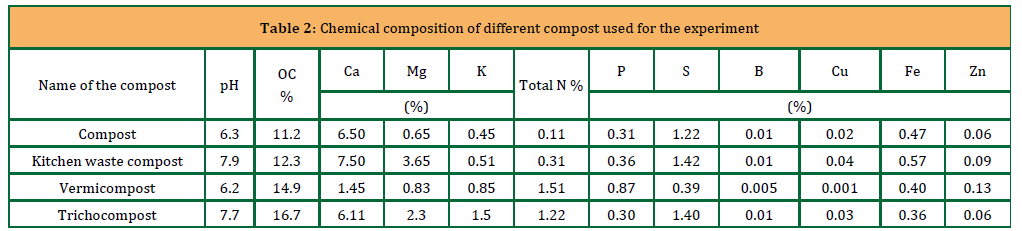
The experiment was laid out in a randomized complete block design (RCBD) with 3 replications. The unit plot size was 4m x 3m, and the variety used was BARI Alu-25. The treatments were as follows: T1 = Control, T2 = 100% Soil Test Based (STB) Fertilizer dose, T3 = 80% STB + Compost @ 2.5 t ha-1, T4 = 80% STB + Kitchen Waste Compost @ 2.5 t ha-1, T5 = 80% STB + Vermicompost @ 2.5 t ha-1, and T6 = 80% STB + Trichocompost @ 2.5 t ha-1. The nutrient status of the initial soil and the chemical composition of different composts are presented in Table 1 and Table 2.

During the last stage of land preparation, several composts were used as an Integrated Plant Nutrient System (IPNS) foundation in combination with chemical fertilizers. The seeds were sown at a spacing of 60 cm x 25 cm. Throughout the growing season, the necessary intercultural activities were carried out to ensure the proper growth and development of the crop. At full maturity, the harvest was completed, and yield and yield-contributing data were collected and analyzed. Means separation was done using least significant differences (LSD) at the 5% probability level.
Carbon stock, carbon accumulation, and soil organic matter (SOM) percentage were calculated using the following formulas
Carbon stock (t ha-1) = Carbon concentration (%) x Bulk density (g cm-3) x Depth (cm)
Carbon accumulation (t ha-1) = Final carbon stock (t ha-1) – Initial carbon stock (t ha-1)
Soil Organic Matter Percentage (SOM %) = Soil Organic Carbon Percentage (SOC %) x 1.74
3. RESULTS AND DISCUSSION
The study aimed to determine the impact of varying irrigation intervals on the growth, productivity, and quality of lemon crops. In our nation, different irrigation intervals are used just for the production of agricultural products. In this endeavour, therefore, various irrigation intervals are used for yielding lemons in an equitable way.
Here is the text as you requested without any changes:
3.1 Effect of integrated nutrient management on yield and economics of potato
The better performance of potato yield was observed in integrated treatment compared to sole chemical treatment (Table 3). In 2022-23, the highest tuber yield of 35.94 t ha-1 was obtained in the treatment T5 (80% STB + vermicompost @ 2.5 t ha-1). Treatment T6 (80% STB + trichocompost @ 2.5 t ha-1) gave the second highest tuber yield (33.79 t ha-1) which was statistically identical to T4 (80% STB + kitchen waste compost @ 2.5 t ha-1). In 2023-24, the maximum tuber production of 33.50 t ha-1 and maximum BCR 3.45 were also observed in vermicompost treated treatment and it makes 14.17 % yield increase over STB dose. This result matched the findings of an earlier study, which found that the highest tuber yield of 336 q ha-1 was obtained when 75% NPK was applied using chemical fertilizers in conjunction with 5 t ha-1 vermicompost (Rajiv, 2014). Other studies, including also found the same thing. The control treatment had the lowest tuber yield (20.19 t ha-1) (Meena et al., 2013; Kumar et al., 2011).
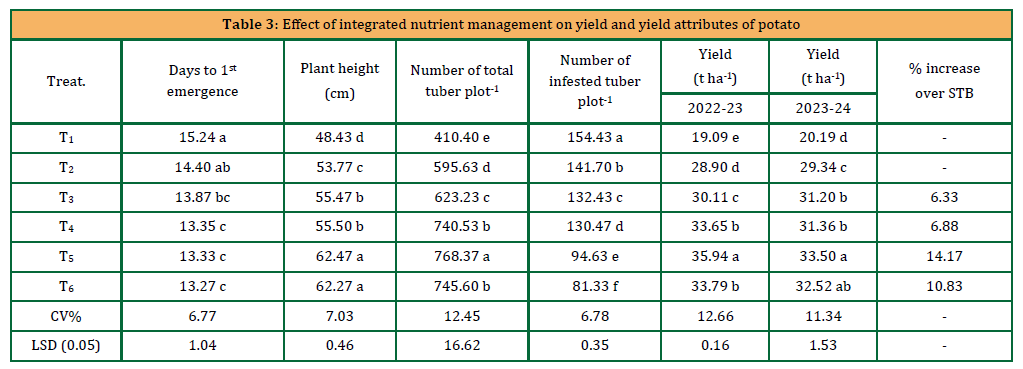
Means in a column followed by same letter(s) do not differ significantly at 5% level by LSD. Note: T1 = Control, T2 = 100% STB, T3 = 80% STB + Compost @ 2.5 t ha-1, T4 = 80% STB + Kitchen Waste Compost @ 2.5 t ha-1, T5 = 80% STB + Vermicmpost @ 2.5 t ha-1, T6 = 80% STB + Trichocompost @ 2.5 t ha-1
Input: Urea=22 Tk kg-1, TSP= 22 Tk kg-1, MoP = 15 Tk kg-1, Gypsum = 12 Tk kg-1, Zinc sulphate = 200 Tk kg-1 Boric acid = 250 Tk kg-1, Compost =10 Tk kg-1, Kitchen waste compost =15 Tk kg-1, Vermicompost=15 Tk kg-1, Trichocompost=15 Tk kg-1
Output: Price range of potato is 15 to 25 Tk kg-1, average price is 20 Tk kg-1
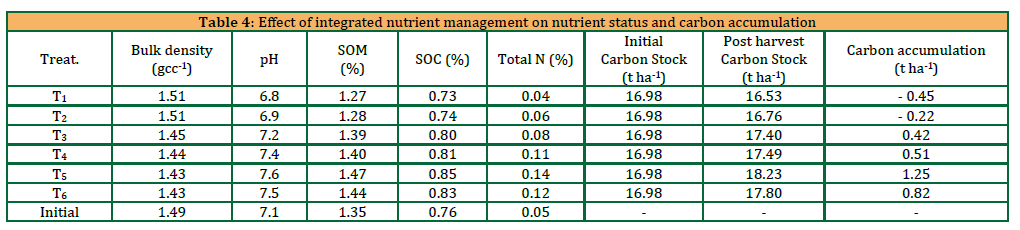
Note: T1 = Control, T2 = 100% STB, T3 = 80% STB + Compost @ 2.5 t ha-1, T4 = 80% STB + Kitchen Waste Compost @ 2.5 t ha-1, T5 = 80% STB + Vermicmpost @ 2.5 t ha-1, T6 = 80% STB + Trichocompost@ 2.5 t ha-1
3.3 Cost and return analysis
Table 5 showed the cost and return analysis of potato as influenced by integrated application of different compost and chemical fertilizer. The highest gross return (Tk 670000 ha-1), gross margin (Tk 467000 ha-1) and MBCR (3.22) were recorded from T5 (80% STB + vermicompost @ 2.5 t ha-1) treatment. Among the treatment, the lowest gross return (Tk 403800 ha-1) and gross margin (Tk 263800 ha-1) were recorded from control treatment.
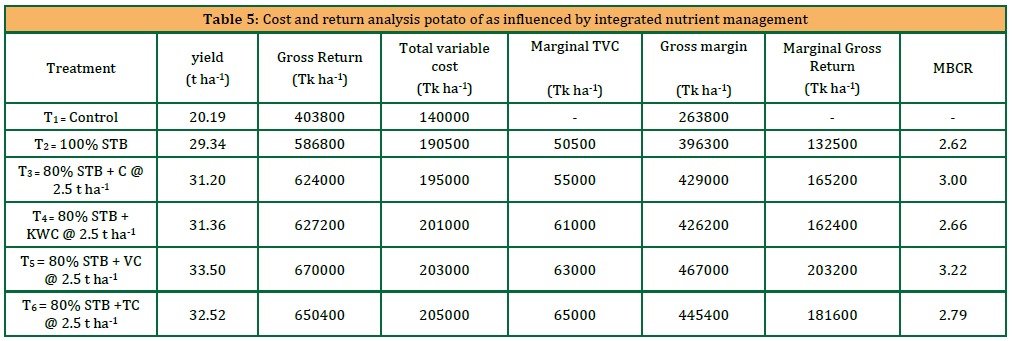
Note: Input: Urea=22 Tk kg-1, TSP= 22 Tk kg-1, MoP = 15 Tk kg-1, Gypsum = 12 Tk kg-1, Zinc sulphate = 200 Tk kg-1 Boric acid = 250 Tk kg-1, Compost =10 Tk kg-1, Kitchen waste compost =15 Tk kg-1, Vermicompost=15 Tk kg-1, Trichocompost=15 Tk kg-1
Output: Average price of Potato is 20 Tk kg-1
4. CONCLUSIONS
The findings showed that when compared to conventional compost, treatments treated with vermicompost perform better. From economic point of view, this treatment was suitable and economically viable. So, it can be concluded that, treatment package consists of 80% STB with vermicompost @ 2.5 t ha-1 may therefore be recommended as a better option for enhancing potato yield and promoting soil carbon buildup.
REFERENCES
Biswas, S., and Dutta, D., 2019. Effect of integrated nutrient management on nutrient uptake, yield and quality of potato (Solanum tuberosum L.). International Journal of Chemical Studies, 8 (1), Pp., 432-446.
Chandini, Kumar, R., Kumar, R., and Prokash, O.M., 2019. The Impact of chemical fertilizers on our environment and ecosystem. In: Research Trends in Environmental Sciences, Edition 2nd & Chapter, 5, Pp., 69-86.
Hensh, S., Malik, G.C., Benergee, M., and Shankar, T., 2020. Studies on integrated nutrient management in productivity and economics of potato (Solanum tuberosum L.) under red and lateritic belt of West Bengal. The Pharma Innovation Journal., 9 (12), Pp. 15-18.
Kumar, M., Baishya, L.K., Ghosh, D.C., Gupta, V.K., 2011. Yield and quality of potato (Solanum tuberosum L.) tubers as influenced by nutrient sources under rainfed condition of Meghalaya. Indian Journal of Agronomy, 56, Pp. 260-266.
Meena, B.P., Kumar, A., Meena, S.R., Shiva, D., Rana, D.S., Rana, K.S., 2013. Effect of sources and levels of nutrients on growth and yield behaviour of popcorn (Zea mays) and potato (Solanum tuberosum) sequence. Indian Journal of Agronomy, 58 (4), Pp. 474-479.
Narayan, S., Kanth, R.H., Narayan, R., Khan, F.A., Singh, P., and Rehman, S.U., 2013. Effect of integrated nutrient management practices on yield of Potato. Potato Journal, 40 (1), Pp., 84-86.
Ogundare, S.K., Babalola, T.S., Hinmikaiye, A.S., and Oloniruha, J.A., 2015. Growth and Fruit Yield of Tomato as Influenced by Combined Use of Organic and Inorganic Fertilizer in Kabba, Nigeria. European J. Agric. Forestry Res., 3 (3), Pp. 48-56.
Rajiv. 2014. On-farm evaluation of integrated nutrient management in potato (Solanum tuberosum L.) under south-western semi-arid zone of U.P. Agriculture Update., (1), Pp. 76-78.
Sahota, T.S., Sharma, R.C., 2005. Fertilizer use research on nitrogen in potato. Fertilizer News, 30 (5), Pp., 41-49.
Shubha, A.S., Srinivasa, V., Shanwaz, A., Anusha, R.B., Sharavathi, M.B., 2018. Effect of Integrated Nutrient Management on Growth and Yield Attributes in Potato (Solanum tuberosum L.). Int J Curr Microbiol App Sci., 7 (09), Pp., 830-836.
West, T.O., and Six, J., 2007. Considering the influence of sequestration duration and carbon saturation on estimates of soil carbon capacity. J. of climate change, 80 (1), Pp. 25-41.

| Pages | 04-07 |
| Year | 2025 |
| Issue | 1 |
| Volume | 5 |


