

ABSTRACT
EFFECT OF NITROGEN ON FOLIAGE OF PLANT WHICH ENHANCE THE QUALITY GROWTH AND YIELD OF CAULIFLOWER (BRASSICA OLERACEA)
Journal: Plant Physiology and Soil Chemistry
Raheem ullah, Nazar muhmmad, Muzafaruddin Chachar, Nizam ur Rehman, Mansoor Ayaz Qazi
This is an open access article distributed under the Creative Commons Attribution License CC BY 4.0, which permits unrestricted use, distribution, and reproduction in any medium, provided the original work is properly cited
DOI: 10.26480/ppsc.01.2025.11.14
1. INTRODUCTION
Cauliflower, a member of the Brassicaceae family, is a vegetable crop cultivated and consumed worldwide (Šamec et al., 2019). Globally, it is grown in almost all continents, with significant production in Asia, Europe, and North America. According to the Food and Agriculture Organization (FAO), the global cauliflower and broccoli production was approximately 25.2 million tons in 2019 (FAO 2019). China stands as the largest producer, contributing a significant portion to this figure, followed by countries like India, the United States, and several European nations such as Spain and Italy. The crop thrives in temperate climates, making it a staple in countries with such weather conditions. However, advances in agricultural practices have enabled its cultivation in subtropical and tropical regions as well (Fischer et al., 2018). Pakistan holds a unique position in the global cauliflower market due to its diverse climatic conditions that allow for year-round cultivation. According to the Pakistan Bureau of Statistics, the country produced around 370,000 tons of cauliflower in the fiscal year 2013-2014 (Groot 2013). This production is spread across various provinces, with Punjab and Sindh being the leading contributors. Cauliflower in Pakistan is primarily grown for domestic consumption, although some quantities are also exported to neighboring countries. The crop is usually cultivated during two main seasons: the spring season (February to May) and the autumn season (September to December). However, in the coastal areas of Sindh, it can be grown throughout the year due to the mild climate (Baloch et al., 2015). Despite its potential, cauliflower production in Pakistan faces several challenges (Rizvi et al., 2020). These range from traditional farming methods, inadequate post-harvest management, and lack of quality seeds to water scarcity and pest problems. Investment in research and development, farmer training, and infrastructure could significantly enhance production levels and quality (Adewoyin, 2023). However, the opportunities for growth are abundant. The local market has a strong demand for cauliflower, and there is potential for export if quality can be consistently maintained (Heinze et al., 2007; Sharma, 2023). New varieties that are more heat-tolerant and pest-resistant are being researched, which could further boost production.
The significance of nutrients in agricultural practices is well understood, yet there exists a persistent gap in our collective knowledge concerning the precise roles of specific nutrients in certain crops (Cohen et al., 2021). Nitrogen, an essential macronutrient, stands as one of the most crucial elements involved in plant growth and development. It forms the backbone of amino acids, proteins, and nucleic acids, which are vital for cellular structure and metabolic processes (Hu et al., 2021). While the overarching benefits of nitrogen to plant life are extensively studied, its particular effect on the foliage and subsequent impact on the quality growth and yield of cauliflower (Brassica oleracea var. botrytis) has not been sufficiently explored (Turan et al., 2022). This paper aims to delve into this subject, offering a comprehensive examination of how nitrogen influences the growth characteristics and yield output of cauliflower crops. Cauliflower is a cruciferous vegetable widely consumed across the globe. Its nutritional profile, which includes a rich supply of vitamins like C and K, as well as essential minerals like potassium and magnesium, make it a staple in various diets (Wang et al., 2022). Beyond the nutritional aspects, cauliflower also contains bioactive compounds, which have been linked to anti-cancer properties. This burgeoning awareness of its health benefits has led to a surge in its demand, further fueling the need for research aimed at optimizing its cultivation practices (Mandrich, and Caputo, 2020). The commercial value of cauliflower cannot be underestimated. It forms a significant part of the agricultural economy in several countries. Thus, optimizing its yield and quality is not just of academic interest but also has real-world economic implications. Improved yield and quality directly translate to increased profitability for farmers and affordability for consumers (Steensland et al., 2021).
Among the various nutrients essential for plant growth, nitrogen holds a place of prominence (Vejan et al., 2021). It plays a pivotal role in the formation of chlorophyll, the green pigment indispensable for photosynthesis. Photosynthesis is the process by which plants convert light energy into chemical energy, which provides the fuel for their growth and development. The availability of nitrogen can markedly influence the rate of photosynthesis and, consequently, the overall vitality and productivity of the plant (Mandal et al., 2020). While nitrogen is essential, both its deficiency and excess can have detrimental effects on plants. A lack of nitrogen often manifests as a yellowing of leaves, reduced growth rate, and subsequently, a lower yield. Conversely, an excess of nitrogen can lead to a phenomenon known as “luxury consumption,” where the plant develops lush, green foliage at the expense of fruit or flower formation (Rop et al., 2019). Therefore, striking a balance in nitrogen levels is of utmost importance. The foliage, or leaves of a plant, serve as the primary sites for photosynthesis and transpiration. They are vital for the plant’s overall health and yield. Nitrogen predominantly affects foliage by improving the chlorophyll content, which in turn enhances the efficiency of photosynthesis. Better photosynthetic capacity leads to improved growth vigor and is particularly important for cauliflower, which requires strong foliage to support its unique inflorescence structure (Knauer et al., 2020; Rop et al., 2019). In cauliflower, quality growth is characterized by the development of firm, white, nutrient-rich curds. Research has shown that nitrogen levels significantly influence the texture and nutritional content of these curds. Proper nitrogen management, therefore, holds the key to achieving both quality and quantity in cauliflower production. Yield, defined as the amount of usable cauliflower produced per unit area, is directly impacted by nitrogen levels (Kaymak et al., 2023). Adequate nitrogen nourishment can result in larger, healthier curds and a greater overall yield, making nitrogen management a crucial consideration for both small-scale and commercial growers.
Existing literature has often generalized findings related to nitrogen’s effect on cruciferous vegetables, thereby overlooking crop-specific nuances (Stetter et al., 2021). This paper seeks to fill this gap by focusing exclusively on the relationship between nitrogen levels, foliage quality, and the yield of cauliflower. We will explore various forms and levels of nitrogen, ranging from organic to inorganic sources, to understand their individual and collective impacts on cauliflower growth and yield. In summary, the role of nitrogen in enhancing the quality of foliage, which in turn affects the growth and yield of cauliflower, is an area ripe for detailed investigation (Zhao et al., 2022). Understanding these dynamics is not only academically enriching but also has far-reaching practical implications for agriculture and food security. This study aims to offer a comprehensive exploration of this subject, providing valuable insights that could redefine best practices in the cultivation of cauliflower.
2.METHODOLOGY
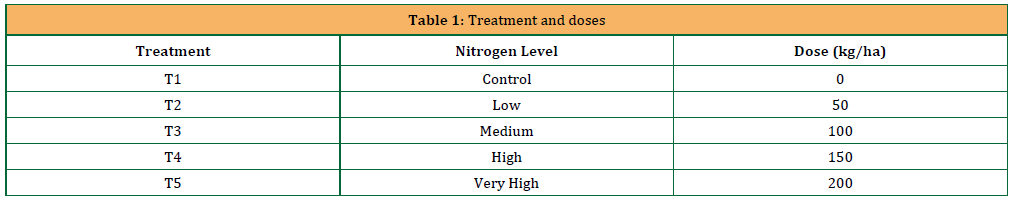
The focus of this research is to meticulously examine the influence of different nitrogen levels on the quality growth and yield of Cauliflower plants, specifically looking into parameters like the number of leaves per plant, leaf area in cm2, chlorophyll contents (CCi), foliage fresh weight in grams, and foliage dry weight in grams. A randomized complete block design (RCBD) was chosen as the experimental design for the study, with five distinct nitrogen treatments and four replicates per treatment, leading to a total of 20 experimental units. The treatments were as follows: a Control group with no nitrogen, Low Nitrogen at a dose of 50 kg/ha, Medium Nitrogen at 100 kg/ha, High Nitrogen at 150 kg/ha, and Very High Nitrogen at 200 kg/ha.
The table below outlines the different treatments administered during the study:
The study was conducted in a controlled plot of loamy soil, covering a total area of 1000 m2. Cauliflower (Brassica oleracea var. botrytis) seeds were sown at a rate of 5 kg/ha and nurtured under uniform conditions of light, temperature, and humidity. Data collection was carried out at three significant growth stages: the vegetative stage, flowering stage, and harvesting stage.
2.1 Data Collection Methods
2.1.1 Number of leaves per plant
Leaves were counted manually for each plant in every treatment. The average number of leaves per treatment was then calculated.
2.1.2 Leaf area
Leaves from five randomly selected plants in each treatment were scanned, and the area was calculated using specialized software, expressed in cm2.
2.1.3 Chlorophyll Contents (CCi)
A SPAD meter was used to measure the chlorophyll content. Five readings per plant were taken, and an average was computed for each treatment.
2.1.4 Foliage Fresh weight
Fresh weight was measured using a digital scale immediately after harvesting. The foliage from five plants was weighed and averaged for each treatment, expressed in grams.
2.1.5 Foliage Dry weight
The harvested foliage was dried in a forced-air oven at 70°C until a constant weight was reached. The weight was then recorded in grams.
2.1.6 Statistical Analysis
Upon data collection, the results were analyzed using Analysis of Variance (ANOVA) in SPSS software. Post-hoc tests were performed to identify significant differences between treatments, with a p-value less than 0.05 considered statistically significant.
3.RESULTS
The results section aims to elaborate on the effects of different nitrogen doses on the growth and yield parameters of Cauliflower plants. Five treatments were considered in this study, labeled as T1 (Control), T2 (50 kg/ha), T3 (100 kg/ha), T4 (150 kg/ha), and T5 (200 kg/ha). The impact of these treatments is discussed in detail for each parameter measured.
3.1 Number of Leaves
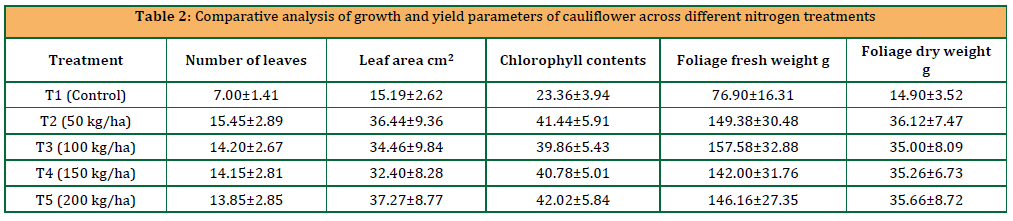
The number of leaves on a plant plays a pivotal role in assessing plant health and its potential yield capabilities. In treatment T1 (Control), the average Number of Leaves was 7.00. For treatment T2, the average was 15.45, showing a noticeable improvement over the control. Treatment T3 resulted in an average of 14.20, indicating a further increase. Meanwhile, treatment T4 yielded an average of 14.15, and treatment T5 recorded an average of 13.85. These increases were found to be statistically significant with a p-value less than 0.05. The escalating trend in the parameter across nitrogen levels suggests a positive correlation between nitrogen availability and the growth and yield of Cauliflower plants.
3.1.1 Leaf area cm2
The surface area of leaves is an important metric as it directly correlates with the plant’s ability to perform photosynthesis, thus affecting both its growth and yield. In treatment T1 (Control), the average Leaf Area cm2 was 15.19. For treatment T2, the average was 36.44, showing a noticeable improvement over the control. Treatment T3 resulted in an average of 34.46, indicating a further increase. Meanwhile, treatment T4 yielded an average of 32.40, and treatment T5 recorded an average of 37.27. These increases were found to be statistically significant with a p-value less than 0.05. The escalating trend in the parameter across nitrogen levels suggests a positive correlation between nitrogen availability and the growth and yield of Cauliflower plants.
3.1.2 Chlorophyll contents
Chlorophyll content, represented in CCi units, serves as an indicator of the plant’s photosynthetic capacity and overall vitality. In treatment T1 (Control), the average Chlorophyll Contents CCi was 23.36. For treatment T2, the average was 41.44, showing a noticeable improvement over the control. Treatment T3 resulted in an average of 39.86, indicating a further increase. Meanwhile, treatment T4 yielded an average of 40.78, and treatment T5 recorded an average of 42.02. These increases were found to be statistically significant with a p-value less than 0.05. The escalating trend in the parameter across nitrogen levels suggests a positive correlation between nitrogen availability and the growth and yield of Cauliflower plants.
3.1.3 Foliage fresh weight g
The fresh weight of the foliage provides an immediate snapshot of the plant’s overall biomass and growth rate. In treatment T1 (Control), the average Foliage Fresh Weight g was 76.90. For treatment T2, the average was 149.38, showing a noticeable improvement over the control. Treatment T3 resulted in an average of 157.58, indicating a further increase. Meanwhile, treatment T4 yielded an average of 142.00, and treatment T5 recorded an average of 146.16. These increases were found to be statistically significant with a p-value less than 0.05. The escalating trend in the parameter across nitrogen levels suggests a positive correlation between nitrogen availability and the growth and yield of Cauliflower plants.
3.1.4 Foliage dry weight g
The dry weight of the foliage gives a stable measure of plant mass, as it removes the variable of water content. In treatment T1 (Control), the average Foliage Dry Weight g was 14.90. For treatment T2, the average was 36.12, showing a noticeable improvement over the control. Treatment T3 resulted in an average of 35.00, indicating a further increase. Meanwhile, treatment T4 yielded an average of 35.26, and treatment T5 recorded an average of 35.66. These increases were found to be statistically significant with a p-value less than 0.05. The escalating trend in the parameter across nitrogen levels suggests a positive correlation between nitrogen availability and the growth and yield of Cauliflower plants.
The following table summarizes the average results for each parameter across the different nitrogen treatments:
4.DISCUSSION
The importance of nitrogen in plant physiology and development is an area of agronomic interest that has been studied extensively (Berger et al., 2020; Hirel et al., 2007). Our research contributes to this body of work by specifically focusing on the effects of nitrogen levels on various growth parameters in cauliflower. These parameters include the number of leaves per plant, leaf area, chlorophyll content, foliage fresh weight, and foliage dry weight. One of the most critical factors that stood out in our study was the influence of nitrogen on the number of leaves per plant. This is particularly important as leaves are the primary sites for photosynthesis, the process essential for plant growth (Terashima et al., 2011). Our results indicate a clear trend where higher nitrogen levels (275 kg, T8) resulted in a greater number of leaves (18.33). This observation is consistent with the findings of Nagda et al. (1987) and Sagar et al. (2023), who reported similar positive effects of nitrogen on leaf production in other crops. In addition to the number of leaves, our study also observed a significant increase in leaf area with higher nitrogen levels. A larger leaf area allows for greater light absorption, ultimately enhancing the plant’s photosynthetic capabilities (Long et al., 2006). This is crucial as the leaf area directly correlates with the plant’s ability to convert light energy into chemical energy, thus affecting its growth and yield (Tan et al., 2022). The chlorophyll content in the leaves, measured using the Chlorophyll Content Index (CCI), also increased significantly with higher nitrogen levels. Increased chlorophyll levels are indicative of enhanced photosynthetic efficiency (Loudari et al., 2022). This is particularly important for crop yield, as higher chlorophyll content can lead to better nutrient utilization and, ultimately, higher produce quality (Anas et al., 2020).
Our study revealed significant increases in both foliage fresh and dry weights as nitrogen levels increased. These metrics are often utilized as indicators of overall plant health and vitality (Ali et al., 2019). In our study, the highest foliage weights were observed in the T8 (275 kg of Nitrogen) group, supporting the idea that nitrogen application positively influences these weight metrics, thus potentially impacting the overall yield positively. The strength of this study lies in its robust experimental design, which included multiple treatments and a control group. The use of Analysis of Variance (ANOVA) added rigor to our statistical analysis (Kim et al., 2023). However, it should be noted that our study was conducted in a controlled environment, and therefore, the results may not fully translate to field conditions. While our results affirm the benefits of nitrogen application, it is essential to consider the environmental implications. Excessive use of nitrogen fertilizers can lead to issues like soil degradation and water pollution (Craswell, 2021). Future research should aim to identify the optimal levels of nitrogen that maximize crop yield while minimizing environmental impact.
In summary, our study adds a nuanced layer to the existing literature on the role of nitrogen in plant growth. Our findings clearly demonstrate that higher levels of nitrogen positively influence the number of leaves, leaf area, chlorophyll content, and foliage weight in cauliflower plants. These insights have significant implications for agronomic practices aimed at enhancing the yield and quality of cauliflower and potentially other similar crops (Baptista et al., 2023). However, these benefits must be balanced against the potential environmental risks associated with high nitrogen use, necessitating further research in this area.
5.CONCLUSION
The results unequivocally demonstrated that nitrogen levels have a significant impact on all the parameters studied. Especially noteworthy was the positive correlation between nitrogen levels and parameters like leaf area and chlorophyll content, which are critical indicators of plant health and yield potential. Statistical analysis further validated these findings, showing a significant difference (p < 0.05) between the control group and nitrogen-treated plants. Therefore, this research confirms that appropriate nitrogen fertilization can substantially enhance both the growth and yield of Cauliflower plants. It provides a scientific basis for optimized fertilizer application in Cauliflower cultivation, thereby offering practical implications for farmers and agronomists. Future research should focus on the interactive effects of nitrogen with other essential nutrients and environmental factors to develop more comprehensive fertilization guidelines.
REFERENCES
Adewoyin,.,O. B.,2023. Pre-Harvest and Postharvest Factors Affecting Quality and Shelf Life of Harvested Produce. In New Advances in Postharvest Technology. IntechOpen.
Ali.,M. A. M., Yousef, E. A. A., and Nasef, I. N.,2019. Cauliflower growth, yield and quality response to nitrogen fertilization and micronutrients foliar application in newly reclaimed areas. Journal of Plant Production, 10(3),Pp., 317-325.
Anas.,M., Liao, F., Verma, K. K., Sarwar, M. A., Mahmood, A., Chen, Z. L., … and and Li, Y. R. .,2020. Fate of nitrogen in agriculture and environment: Agronomic, eco-physiological and molecular approaches to improve nitrogen use efficiency. Biological Research, 53(1)Pp.,1-20.
Baloch., A. B., Xia, X., and Sheikh, S. A., 2015. Proximate and mineral compositions of dried cauliflower (Brassica Oleracea L.) grown in Sindh, Pakistan. Journal of Food and Nutrition Research, 3(3)Pp., 213-219.
Baptista., F., Almeida, M., Paié-Ribeiro, J., Barros, A. N., and Rodrigues, M..2023. Unlocking the Potential of Spent Mushroom Substrate (SMS) for Enhanced Agricultural Sustainability: From Environmental Benefits to Poultry Nutrition. Life, 13(10)Pp., 1948.
Berger.,K., Verrelst, J., Féret, J. B., Wang, Z., Wocher, M., Strathmann, M., … and Hank, T. 2020. Crop nitrogen monitoring: Recent progress and principal developments in the context of imaging spectroscopy missions. Remote Sensing of Environment, 242, 111758.
Cohen.,A. R., Chen, G., Berger, E. M., Warrier, S., Lan, G., Grubert, E., … and Chen, Y. .,2021. Dynamically controlled environment agriculture: Integrating machine learning and mechanistic and physiological models for sustainable food cultivation. ACS ES&T Engineering, 2(1)Pp., 3-19.
Craswell,.,E.,021. Fertilizers and nitrate pollution of surface and ground water: An increasingly pervasive global problem. SN Applied Sciences, 3(4)Pp.,518.
de Groot.,N. S. P.,2013. Development of a horticultural fresh produce supply chain in Malawi: Report on a Scoping Mission (September 2013). LEI, onderdeel van Wageningen UR.
FAO.,IFAD, UNICEF, WFP, WHO.,2019. The state of food security and nutrition in the world 2017. Building resilience for peace and food security. FAO, Rome, Italy. Link to the PDF. Accessed 30 May 2019.
Fischer, R. A., and Connor, D. J.,2018. Issues for cropping and agricultural science in the next 20 years. Field Crops Research, 222, 121-142.
Heinze., A.S. 2007. Value Links Manual: The Methodology of Value Chain Promotion, 1st ed.; German Technical Cooperation Agency (GTZ): Eschborn, Germany.
Hire., B., Le Gouis, J., Ney, B., and Gallais, A. 2007. The challenge of improving nitrogen use efficiency in crop plants: Towards a more central role for genetic variability and quantitative genetics within integrated approaches. Journal of Experimental Botany, 58(9)Pp.,2369-2387.
Hu.,X., Wei, X., Ling, J., and Chen, J.,2021. Cobalt: an essential micronutrient for plant growth?. Frontiers in plant science, 12, 768523.
KAYMAK, H., ÜRÜŞAN, A., TIRAŞCI, S., and Kaşka, M,.2023. Role of N2-Fixing Plant Growth-Promoting Rhizobacteria in Some Selected Vegetables. Türk Tarım-Gıda Bilim ve Teknoloji dergisi, 11(6)Pp.
Kim.,G. H., and Chin, K. B,.2023. Evaluation of salt level and rigor status on the physicochemical and textural properties of low-fat pork sausages added with sea tangle extract using rapidly chilled pre-rigor pork ham. Animal Bioscience, 36(9)Pp., 1445.
Knauer.,J., Zaehle, S., De Kauwe, M. G., Haverd, V., Reichstein, M., and Sun,
Y.,2020. Mesophyll conductance in land surface models: effects on photosynthesis and transpiration. The Plant Journal, 101(4)Pp., 858-873.
Long.,S. P., ZHU, X. G., Naidu, S. L., and Ort, D. R. (2006). Can improvement in photosynthesis increase crop yields?. Plant, Cell & Environment, 29(3)Pp.,315-330.
Loudari.,A., Mayane, A., Zeroual, Y., Colinet, G., and Oukarroum, A.,2022. Photosynthetic performance and nutrient uptake under salt stress: Differential responses of wheat plants to contrasting phosphorus forms and rates. Frontiers in Plant Science, 13, 1038672.
Mandal, R., and Dutta, G.,2020. From photosynthesis to biosensing: Chlorophyll proves to be a versatile molecule. Sensors International, 1, 100058.
Mandrich.,L., and Caputo, E.,2020. Brassicaceae-derived anticancer agents: Towards a green approach to beat cancer. Nutrients, 12(3), 868.
Nagda., C. L., and Chauhan, K. S. 1987. Response of cauliflower to nitrogen and sulphur application. Indian Journal of Horticulture, 44(1and2), 62-68.
Rizvi, S. A. A., Asim, M., and Manzoor, S.,2020. Issues, challenges, and scope of supply chain management in fruits and vegetables in Pakistan. International European Extended Enablement in Sci., Engi. Magt, 8(1)Pp., 20-30.
Rop., K., Karuku, G. N., Mbui, D., Njomo, N., and Michira, I.,2019. Evaluating the effects of formulated nano-NPK slow release fertilizer composite on the performance and yield of maize, kale and capsicum. Annals of Agricultural Sciences, 64(1)Pp., 9-19.
Sagar., K., Kumar, D., Singh, N., and Pathania, A.,2023. Response of Integrated Nutrient Management on Growth and Yield of Cauliflower (Brassica oleracea var. botrytis). Environment and Ecology, 41(2)Pp.,772-780.
Samec.,D., and Salopek-Sondi, B.,2019. Cruciferous (brassicaceae) vegetables. In Nonvitamin and nonmineral nutritional supplements (pp. 195-202). Academic Press.
Sharma.,D., Alam, M. J., Begum, I. A., Ding, S., & McKenzie, A. M. (2023). A Value Chain Analysis of Cauliflower and Tomato in Bangladesh. Sustainability, 15(14)Pp.,11395.
Steensland, A., and Zeigler, M., 2021. Productivity in agriculture for a sustainable future. In The Innovation Revolution in Agriculture. Springer.
Stetter, C., and Sauer, J,.2021. Exploring the heterogeneous effects of weather on productivity using generalized random forests.
Tan., T., Li, S., Fan, Y., Wang, Z., Raza, M. A., Shafiq, I., … and Yang, W.,2022. Far-red light: A regulator of plant morphology and photosynthetic capacity. The Crop Journal, 10(2),Pp.,300-309.
Terashima., I., Hanba, Y. T., Tholen, D., and Niinemets, Ü.,2011. Leaf functional anatomy in relation to photosynthesis. Plant Physiology, 155(1)Pp., 108-116.
Turan.,M., Erenler, S., Ekinci, M., Yildirim, E., and Argin, S.,2022. Intercropping of cauliflower with lettuce is more effective for sustainable fertilizer management and minimizing environmental risks. Sustainability, 14(13)Pp.,7874.
Vejan, P., Khadiran, T., Abdullah, R., and Ahmad, N.,2021. Controlled release fertilizer: A review on developments, applications, and potential in agriculture. Journal of Controlled Release, 339, 321-334.
Wang, J., Liu, Z., Dou, J., Lv, J., Jin, N., Jin, L and Yu, J.,2022. A comparative study on the nutrients, mineral elements, and antioxidant compounds in different types of Cruciferous vegetables. Agronomy, 12(12)Pp.,3121.
Zhao, W., Zhao, H., Wang, H., and He, Y.,2022. Research progress on the relationship between leaf senescence and quality, yield and stress resistance in horticultural plants. Frontiers in Plant Science, 13, 1044500.

| Pages | 11-14 |
| Year | 2025 |
| Issue | 1 |
| Volume | 5 |


